Looking for a Chicago neighborhood with more than one kind of vintage home? Ravenswood Manor stands out because it is not just a bungalow neighborhood, even though bungalows are a big part of its identity. If you are trying to understand what buyers actually find here, this guide will walk you through the home styles, streetscape, and setting that make Ravenswood Manor feel distinct. Let’s dive in.
What Defines Ravenswood Manor Homes
Ravenswood Manor is a compact residential pocket on the west bank of the North Branch of the Chicago River, bounded by Lawrence Avenue, Montrose Avenue, Sacramento Avenue, and the river. According to the Ravenswood Manor Improvement Association, the neighborhood was first sold beginning in 1909, and the association has worked since 1914 to maintain its park-like character.
That early planning still shapes how the area feels today. A neighborhood study draft notes that the neighborhood grew alongside the 1907 Brown Line extension and the straightening of the North Branch, with landscaped parkways, planted trees and shrubs, and deed restrictions that aimed to preserve a consistent residential setting.
Chicago Bungalows in Ravenswood Manor
When people talk about Ravenswood Manor homes, Chicago bungalows usually come first. The Chicago Bungalow Association describes the classic bungalow as a brick house from the 1910s through the mid-1930s, usually 1.5 stories over a full basement, with a low-pitched hipped roof, wide overhangs, generous windows, and a narrow rectangular footprint.
That basic format still appeals to many buyers because it is practical. The Chicago Architecture Center notes that bungalow layouts often include open guest spaces, more private family areas, and attics and basements that can be finished for extra room.
In Ravenswood Manor, the bungalow story is a little broader than the standard citywide version. The local landmark study draft describes a mix of Craftsman and Chicago bungalow forms, mostly in brick, with some stucco and wood-frame homes from the neighborhood’s earlier development still in place.
Beyond Bungalows: More Home Types
One of the most interesting things about Ravenswood Manor is that its housing stock is more varied than its reputation suggests. The same study draft identifies older gable-front houses and American Foursquares, especially on the earliest-developed blocks.
You also see a wider range of early-20th-century styles across the neighborhood. These include Queen Anne, Colonial Revival, Dutch Colonial Revival, Tudor Revival, Italian Renaissance Revival, Prairie, and American Foursquare homes.
For you as a buyer, that variety matters. It means the streets do not feel repetitive, and it also means your options may include different layouts, façade materials, rooflines, porches, and bay-window configurations depending on the block and property.
Courtyard Apartments Add Another Layer
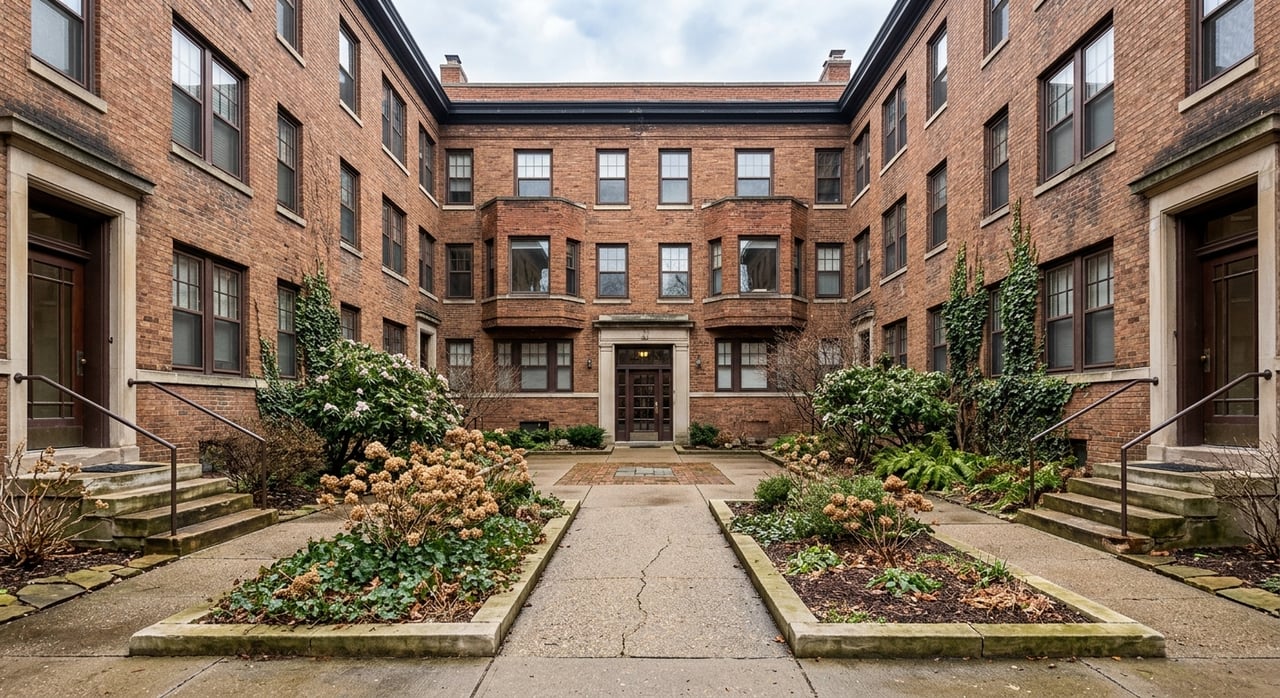
Ravenswood Manor is not made up of single-family homes alone. The neighborhood study draft notes that several corner and courtyard apartment buildings are found here, especially near the Francisco transit station.
That adds an important second housing type to the neighborhood. The Chicago Architecture Center describes Chicago courtyard buildings as three- to four-story brick buildings arranged around a central semi-public garden, with separate entrances that bring in more light, air, and views while offering a greater sense of privacy.
If you like vintage architecture but do not need a detached house, courtyard buildings can be an appealing alternative. They offer a middle-density housing style that feels more residential and green than many larger apartment formats.
Why the Streetscape Feels Different
Ravenswood Manor’s appeal is not only about the houses themselves. It is also about how the neighborhood was planned as a whole.
The landmark study draft explains that the original subdivision included street grading, sidewalks, curbs, gutters, utilities, landscaped parkways, and tree planting. Instead of large front lawns or wide spacing between homes, the blocks were designed with modest setbacks and visual continuity from one property to the next.
That planning helps explain why the neighborhood often feels composed rather than accidental. The homes, sidewalks, parkways, and mature trees work together to create a cohesive setting, which is a big part of Ravenswood Manor’s lasting appeal.
Park and River Setting Matter
Green space is built into the neighborhood experience here. The Chicago Park District says Ravenswood Manor Park was acquired in 1915 and originally included trees, shrubs, benches, a pergola, and a small park building, with later playground improvements added over time.
That park supports the neighborhood’s small-scale, landscaped character. It is not an afterthought. It fits the original vision of a residential district shaped by greenery and shared public space.
The river adds another layer. The Chicago Public Library describes Ravenswood Manor as being on the west bank of the North Branch of the Chicago River, and the local study draft notes that river frontage was originally reserved for shared boat access, with some current properties still retaining private river access.
For buyers, that river edge can make the neighborhood feel noticeably different from other North Side pockets. You get a residential street grid, but also a real waterfront presence that contributes to the area’s identity.
What Buyers Often Notice First
If you are touring homes in Ravenswood Manor, adaptability is one of the first practical strengths you may notice. Bungalows, in particular, were designed with attics and basements that could be finished for additional living space, which is one reason they continue to work well for modern households.
You may also notice how the neighborhood balances density with greenery. Detached homes, courtyard buildings, landscaped parkways, and the river setting all exist within a fairly compact footprint.
That combination gives Ravenswood Manor a layered feel. It is not defined by just one building type or one visual theme, but by the way vintage homes, multifamily buildings, streetscape design, park space, and water all fit together.
How to Think About Homes Here
If you are considering a move to Ravenswood Manor, it helps to evaluate homes in context, not just in isolation. A bungalow may offer flexible expansion space in the attic or basement, while another vintage home may offer a different floor plan, a larger corner lot, or more distinctive architectural detailing.
It is also worth paying attention to where a property sits within the neighborhood. Proximity to courtyard buildings, transit, the river, or the park can shape how a block feels and how a home lives day to day.
This is where a detailed, property-specific approach matters. In a neighborhood with multiple vintage housing types, careful analysis of layout, condition, location, and renovation potential can make a real difference in how confidently you buy or sell.
If you want help evaluating Ravenswood Manor homes with a clear, data-driven lens, John Charmelo can guide you through the neighborhood with practical insight, strong market analysis, and hands-on support from search to closing.
FAQs
What kinds of homes are found in Ravenswood Manor?
- Ravenswood Manor includes Chicago bungalows, Craftsman-influenced homes, gable-front houses, American Foursquares, courtyard apartment buildings, and other early-20th-century styles such as Tudor Revival, Prairie, and Colonial Revival homes.
What makes Chicago bungalows in Ravenswood Manor appealing?
- Chicago bungalows are known for practical layouts, full basements, and attic space that can offer extra flexibility for living, work, or guest use.
Are there apartments in Ravenswood Manor or only single-family homes?
- Ravenswood Manor also has courtyard and corner apartment buildings, especially near the Francisco transit station, so the neighborhood includes more than detached houses.
What gives Ravenswood Manor its distinct neighborhood feel?
- Its character comes from the combination of vintage homes, landscaped parkways, mature trees, Ravenswood Manor Park, and the neighborhood’s setting along the North Branch of the Chicago River.
Why does Ravenswood Manor have so much architectural variety?
- The neighborhood developed in the early 20th century over multiple years, which resulted in a mix of bungalow forms, revival styles, and other vintage home types rather than one uniform look.