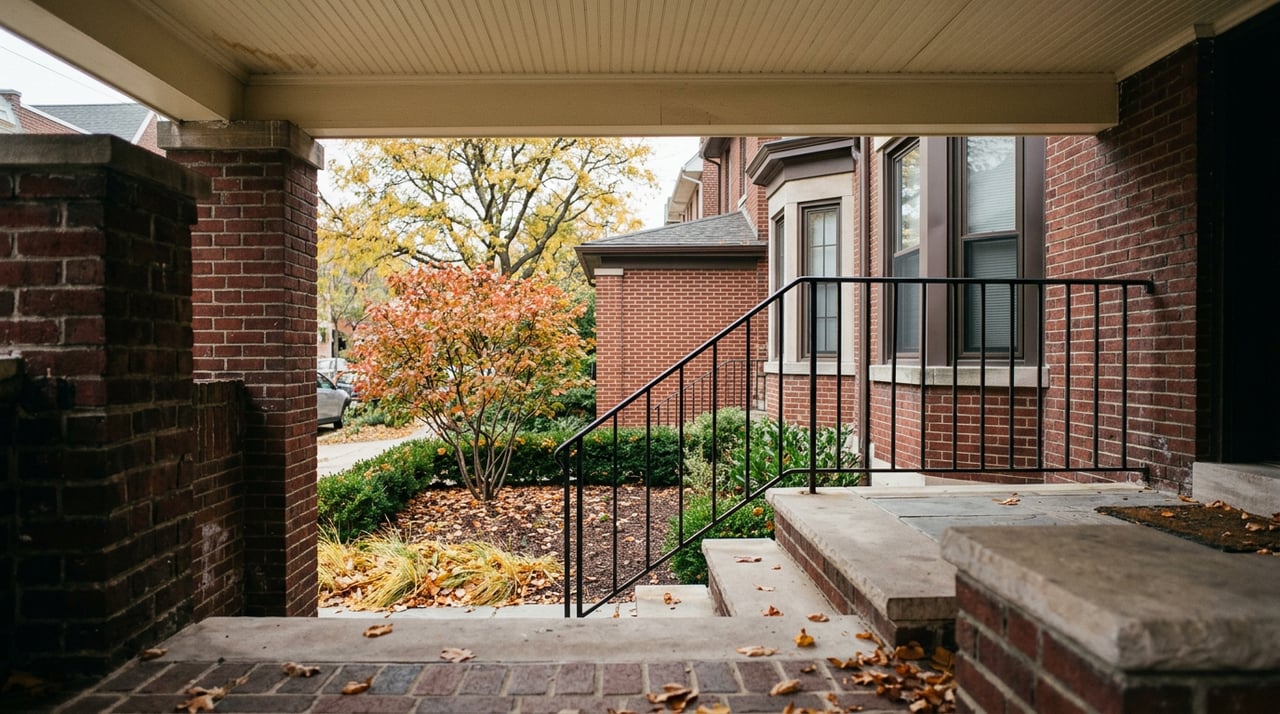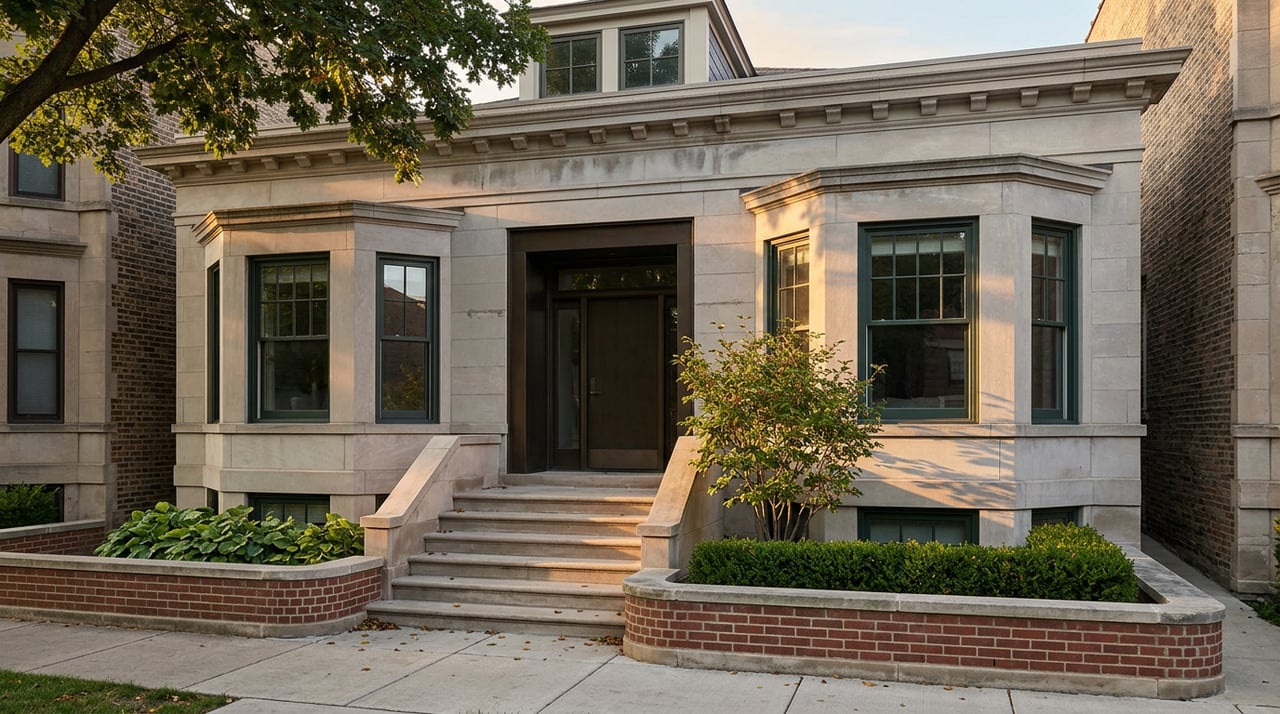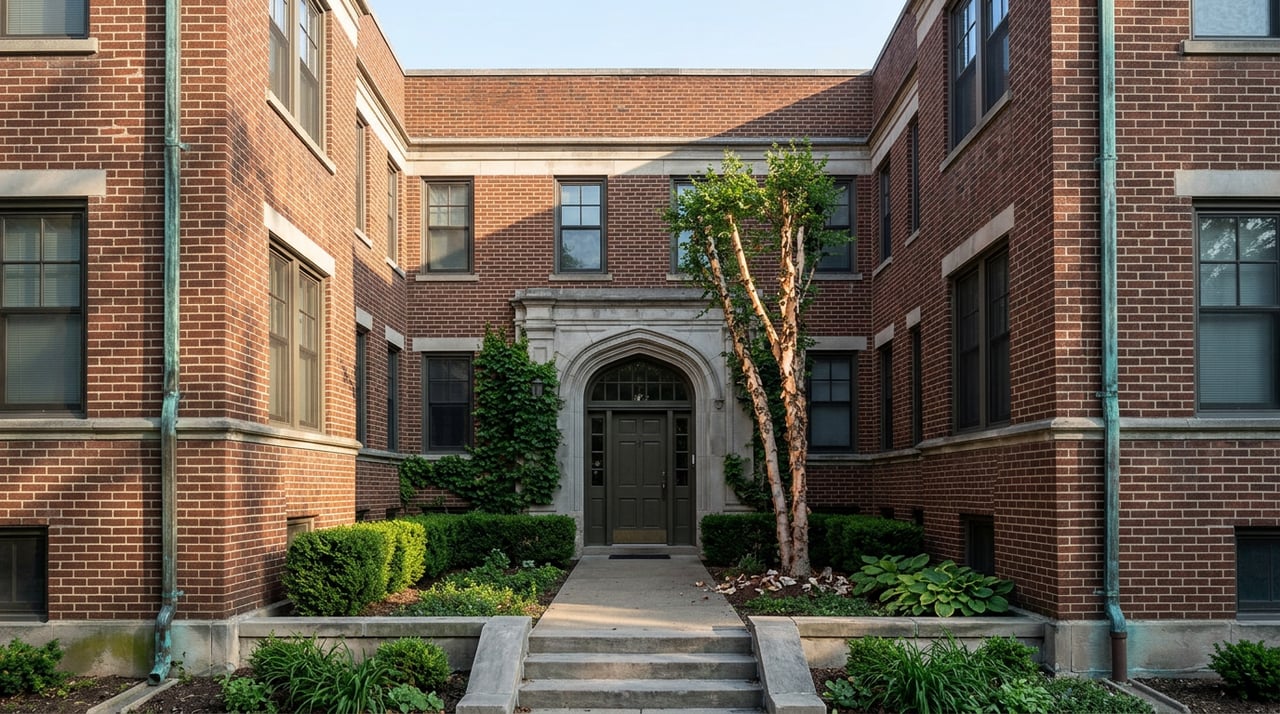
Walk two blocks in Edgewater this fall and you can price two condos at almost the same number per square foot. One sits behind a limestone archway, its unit facing a landscaped courtyard, its radiators clanking through a heating system installed sometime before the Depression. The other doesn't exist yet. It's a permit, a rendering, and a hole in the ground where a surface parking lot used to be. Both will show up in the same search radius. Both will land close to the same median. They are not the same purchase, and the median price Edgewater buyers keep quoting to each other doesn't tell you which one you're looking at.
Edgewater's median sale price sat at $321,000 over the three months ending June 2026, with a median of $258 per square foot, up 2.4 percent from a year earlier. That number is doing a lot of work it shouldn't have to do alone. Condos in the neighborhood have been listing anywhere from $119,000 to $1,250,000 as of August 2026, a spread wide enough to include a studio in a prewar courtyard building and a rooftop-deck unit in a building still under construction. The median is a midpoint between two different bets, and right now those bets are getting more different, not less.
What's Actually Going Up on Sheridan and Kenmore
Start with the new construction, because it's concentrated enough to map. In the last eight months, developers have pulled full permits for four separate condo buildings within a few blocks of each other in Edgewater's Sheridan and Kenmore corridor.
| Address | Units | Permit Date | Reported Cost | Developer / Architect |
|---|---|---|---|---|
| 6150 N. Sheridan Rd. | 40 | May 4, 2026 | $5 million | 6150 N. Sheridan LLC / Hanna Architects, GlobalGC Inc. |
| 6143 N. Kenmore Ave. | 40 | February 2026 | Not disclosed | 4 Star Builders / Hanna Architects |
| 6125 N. Kenmore Ave. | 18 | April 2026 | Not disclosed | 4 Star Builders / Hanna Architects |
| 6027 N. Kenmore Ave. | 24 | July 17, 2026 | $2.7 million | Variable Properties LLC / Vari Architects |
That's 122 new condo units permitted in one pocket of Edgewater in under a year, most of them two-, three-, and four-bedroom layouts with one parking space per unit, a floor plan mix that reads more like owner-occupant housing than investor rental stock. The 6150 Sheridan building alone is targeting a rooftop deck, a basement garage, and completion sometime around the second quarter of 2027, though the developer has already pushed its own timeline once. The 6027 Kenmore lot has its own history worth knowing if you're comparing it to a stabilized building: one of the last surviving homes built by Edgewater's founding developer, John Lewis Cochran, was demolished there in 2017, a seven-story, 15-unit permit followed in October 2021, work never got underway, and Variable Properties only picked the site back up this year with a smaller five-story, 24-unit design. New construction in Edgewater right now means a documented pipeline, not a hypothetical.
The Vote That Could Make Old Buildings Worth Fixing
On the other side of the ledger, something moved this summer that has nothing to do with new permits and everything to do with what a rehab is worth on paper. On June 26, 2026, the Illinois National Register Advisory Council voted to recommend that the National Park Service approve a multiple-property designation covering Chicago's entire class of vintage courtyard buildings, a category that runs into the thousands citywide, including courtyard-style buildings like the Ridgewood Flats at 5743 N. Ridge Ave., sitting right on Edgewater's border with Andersonville.
The mechanism matters more than the headline. A multiple-property listing doesn't landmark any single building. It builds what preservation consultant Emily Ramsey, who prepared the nomination, called an "umbrella document" that lets an individual courtyard building qualify for its own National Register listing without having to prove its architectural significance from scratch. Once a building clears that individual listing, the owner has two genuinely different financial tools available, and which one applies depends entirely on how the unit is used.
If a building is rehabbed for income-producing use, rental units qualify for a 20 percent federal historic tax credit plus a 25 percent Illinois credit, both applied dollar for dollar against qualified rehabilitation costs, with the state credit capped at $3 million per project. If a unit is owner-occupied instead, the relevant tool is different: the Property Tax Assessment Freeze for Historic Residences, which locks in a condo's assessed value for 12 years after a qualifying rehab, provided the owner invests at least 25 percent of the unit's market value in the work. Most Edgewater buyers looking at a vintage courtyard unit for themselves, not as a rental, will care about the second program, not the first. That distinction rarely makes it into general condo-buying guides, and it changes what "historic designation" is actually worth to the person signing the mortgage.
None of this is live yet. The June vote was a recommendation, not a listing. No specific Edgewater courtyard building has been individually designated under this new umbrella as of this writing. What changed is the runway: a process that used to require proving a building's significance alone now runs through a document that already makes the case for the entire building type.
Why the Median Doesn't Show You the Assessment Risk
Here's the part the price-per-square-foot number hides completely. Vintage walk-ups in Edgewater and the surrounding North Side lakefront tend to generate recurring masonry, tuckpointing, roof, window, and heating system work simply because of their age and Chicago's freeze-thaw winters. When that work outpaces what an association's reserve fund has saved, the bill shows up as a special assessment, billed to owners according to their percentage of ownership as set out in the building's declaration, not split evenly per door.
Picture a straightforward version of that math: a building levies $600,000 for façade and balcony repairs, and your unit carries a 1.25 percent ownership share. Your bill is 1.25 percent of $600,000, or $7,500, due on whatever schedule the board sets, often with no option to roll it into your mortgage. A brand-new building on Kenmore Avenue simply doesn't have this exposure yet. Its reserve fund starts at zero deferred maintenance because there's no deferred maintenance to have. The tradeoff is that new associations are also unproven. Nobody knows yet whether the board at 6150 N. Sheridan will fund reserves aggressively or coast on low dues until the first major repair comes due a decade from now.
There's a financing wrinkle that tracks the same divide. Roughly a third of Chicago condo buildings currently carry active FHA approval, and lenders tracking the space note that older buildings in pockets of Rogers Park, Uptown, and Edgewater fall outside that list more often, typically because of deferred maintenance or lower owner-occupancy ratios. A vintage courtyard unit that looks affordable on paper can quietly shrink your buyer pool at resale if the building never bothered with FHA certification. A new construction unit starts that process from scratch, for better or worse.
What This Actually Means If You're Comparing the Two
If you're weighing a vintage courtyard unit against one of the new Sheridan or Kenmore buildings at a similar price, the questions you need answered aren't the same for each.
For the vintage building, ask for the declaration to confirm your exact ownership percentage, the current reserve study and how recently it was updated, the special assessment history for the past five years, and whether the association has any current FHA certification. Ask directly whether the board or any owner has looked into the building's eligibility for the courtyard multiple-property listing, since that conversation is happening in condo board meetings across the city right now even where no application has been filed.
For the new construction, ask for the initial reserve funding plan the developer has built into the declaration, the projected first-year assessment before any units have moved in, and the construction completion timeline in writing, since the 6150 N. Sheridan project has already slipped from its original early-2026 groundbreaking target. New buildings carry construction risk and unproven governance in place of deferred maintenance. That's not a lesser risk. It's a different one, and it deserves the same due diligence a hundred-year-old courtyard building gets.
FAQ
Does the National Register vote affect my property taxes right now if I own a courtyard condo in Edgewater? Not yet. The June 2026 vote was a recommendation to the National Park Service for a multiple-property framework, not an individual listing. A specific building still needs its own listing before an owner can apply for the 12-year Property Tax Assessment Freeze for Historic Residences.
Will the new construction on Sheridan and Kenmore affect what my vintage unit is worth? It's too early to say with certainty, since none of the four buildings has delivered units yet. What's documented is that 122 new condo units are permitted within a few blocks of each other, which will add directly comparable new-construction inventory to a market that has mostly offered vintage stock.
How do I find my ownership percentage before making an offer? It's in the condo declaration, which your attorney should request as part of the standard five-business-day attorney review period on any Illinois condo purchase. Don't assume it's an equal split with your neighbors. It rarely is.
If you're trying to figure out which side of this split actually fits your budget and your risk tolerance, that's exactly the kind of comparison John Charmelo walks Edgewater buyers through before they write an offer. Request a Local Market Review and get the reserve study, the assessment history, and the real math before you decide what your price per square foot is actually buying.